top of page

2026–27 INITIATIVE
UN
ACKNOWLEDGED
Who draws the map, and what does it leave out?
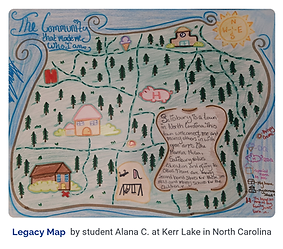
Students spend six lessons on how a legacy survives or gets lost, then build a Legacy Map of a real place and write the Mapmaker's Statement that says why that legacy belongs on it.
ELA
MATH
SCIENCE
SOCIAL STUDIES
Free. Emailed to you.

At a Glance
SUBJECTS
ELA, Math, Science, Social Studies
LESSONS
6 per subject: 1 shared launch, 4 subject lessons, 1 shared showcase
TOPICS
Perspective and voice, the Pythagorean theorem and distance formula, maps as models and the Earth behind them, legacy and the historical record
FINAL PRODUCT
A Legacy Map of a real place, illuminated with the details of one life, plus a Mapmaker's Statement arguing why that legacy belongs on it
FACILITATION GUIDE
Lesson plans for all four subjects, slide decks, student handouts, scoring rubric, standards documentation, contest details
WHAT YOU SUPPLY
Paper, pencils, art materials, rulers, printed handouts
Teach all four subjects, or just yours — each subject's lessons stand on their own.
THE ARCS
Four subjects, four arcs
Lessons 1 and 6 are shared across all four subjects. In between, each subject's four lessons build on each other, toward what that subject contributes to the final product.
ELA
Perspective and voice
CCSS ELA/LITERACY
1
What Do You See?
Reading a real map for what it shows and what it leaves off
2
Whose Voice Is This?
Point of view: who tells a story, and whose voice is missing
3
Same Story, Different Voice
Perspective and tone: what each teller stresses and trusts
4
Finding Your Voice
Voice: word choice, tone and rhythm that sound like one person
5
You're the Mapmaker
Framing and selection, then drafting the legacy in words
6
The Map Gallery
Building the map and finalizing the statement
CONTRIBUTION TO THE PRODUCT
The legacy told in words, in the student's own voice.
MATH
Pythagorean theorem to distance formula
CCSS MATHEMATICS
1
What Do You See?
Reading a real map for what it shows and what it leaves off
2
Locate It
The coordinate plane, ordered pairs and map scale
3
The Tool
Right triangles and the Pythagorean theorem
4
Measure It
Straight-line distance between two points, converted to miles
5
Name It & Tell It
The distance formula, and writing what the distances show
6
The Map Gallery
Building the map and finalizing the statement
CONTRIBUTION TO THE PRODUCT
The real distances between the places on the map.
SCIENCE
Maps as models, and the Earth behind them
NGSS
1
What Do You See?
Reading a real map for what it shows and what it leaves off
2
You Can't Flatten a Sphere
A map as a model, and why flattening a sphere distorts it
3
Why Africa Looks Small
Mercator distortion and the true size of the continents
4
The Shape of the Land
Contour lines and elevation: reading and building a topographic map
5
Follow the Water
The water cycle, watersheds, and why rivers decide where places grow
6
The Map Gallery
Building the map and finalizing the statement
CONTRIBUTION TO THE PRODUCT
What the map keeps true, and what it leaves out.
SOCIAL STUDIES
Legacy and the historical record
C3 FRAMEWORK
1
What Do You See?
Reading a real map for what it shows and what it leaves off
2
The Map That Knew
Primary and secondary sources, and what the 1375 Catalan Atlas preserved
3
The World Mansa Musa Built
Corroborating sources, and judging whether one can be trusted
4
How the Known Became Unknown
How widely held knowledge gets lost, and who holds the pen
5
Put Yourself on the Map
What makes a legacy significant, and drafting the case for it
6
The Map Gallery
Building the map and finalizing the statement
CONTRIBUTION TO THE PRODUCT
The case for why this legacy belongs on the map.
THE PRODUCT
One map, four ways to tell it
Each student picks a person and a legacy to map, themselves or someone they choose. By the gallery they have a map of a real place carrying the details of that life, and a written statement saying why it belongs on the map.
Students who take more than one subject build one map, not four. Each subject adds a section to the same Mapmaker's Statement.
BEFORE YOU TEACH IT
Watch the walkthrough
A run-through of the six lessons, the instructional design, and the build days, so you know what you're walking into before day one.
What it covers
How the facilitation guide delivers your materials, and how to navigate it
How the shared launch works across all four subjects
What a typical lesson looks like start to finish
Running the model build days and the showcase
PACING
When to run it
Unacknowledged is flexible. You can run it any time of year and shape the pacing to fit your school schedule: start earlier in the year, stretch the days out, or run it whenever it makes the most sense for your students.
If you're entering the national contest, the only date to plan around is May 31, when student work is due. If you're not entering, Unacknowledged stands completely on its own.

CONTEST & SHOWCASE
Enter the contest
Every student who finishes gets a certificate. Facilities may submit their student work to the national contest.
Submitting
Portal opens May 24, 2027
Portal closes May 31, 2027
Enter individually or as a group
One product and written statement per entry
Each student can be part of only one entry
For your classroom
Prizes for the winning students
Student participation certificate for every student who finishes
Written feedback for all student submissions
Judging rubric and contest guidelines, so students know what the judges look for (both included in the facilitation guide)
GET IT
Request the materials
Fill out the form and we'll email you the full facilitation guide, free.
Form not working? Follow this link.
Questions? Need the materials in a different format? Email initiatives@breakfree-ed.org.
bottom of page